
The Short Answer
Correct identification is the single decision that determines whether a pest or disease problem gets solved or gets worse. Treating a fungal disease with an insecticide, or spraying a beneficial insect because it resembles a pest, wastes time and money and often makes the underlying issue harder to fix.
What Accurate Identification Actually Requires
Identification isn’t just naming an insect or a spot on a leaf — it requires connecting the organism or pathogen itself, the specific damage pattern it produces, and the plant it’s affecting, since the same symptom can mean different things on different hosts. The University of California’s Statewide Integrated Pest Management Program (UC IPM) builds its identification guides around exactly this structure, pairing photographs of pests and damage with information on which plants are affected and under what conditions. This is why a single blurry photo rarely settles a diagnosis.
A Step-by-Step Approach to Identifying an Unknown Problem
- Isolate the symptom. Localized damage often points to insects or mechanical injury; uniform, spreading damage often points to disease or an environmental cause.
- Look for the causal organism, not just the damage. Turn leaves over, check stems and soil line, and look for actual insects, eggs, webbing, or fungal growth.
- Record the timing and speed of spread. Fungal blights often spread fastest in warm, humid conditions; many insect pests show up in generational waves tied to temperature.
- Compare against a verified reference source, such as UC IPM’s pest and disease galleries or the Royal Horticultural Society’s (RHS) advice pages, rather than a generic image search.
- Rule out non-living causes. Nutrient deficiency, overwatering, and sunscald can all mimic pest or disease symptoms.
- Confirm before treating, especially for food crops, severe damage, or an unfamiliar-looking organism.
Pests vs. Diseases: How to Tell Which You’re Dealing With
Pests are living organisms — insects, mites, nematodes, slugs — that feed on or damage a plant directly. Diseases are caused by pathogens: fungi, bacteria, viruses, and viroids. A practical rule of thumb: chewed, holed, skeletonized, or sucked foliage usually indicates a pest. Spots with defined margins, powdery or fuzzy coatings, cankers, or wilting that starts from one side of the plant usually indicates disease. Overlap does happen — some insects transmit viruses as they feed — which is why a single visual cue is rarely enough on its own.
Common Pest and Disease Categories and Their Telltale Signs
- Sap-sucking insects (aphids, whiteflies, spider mites): stippled or yellowing leaves, sticky honeydew residue, curled new growth.
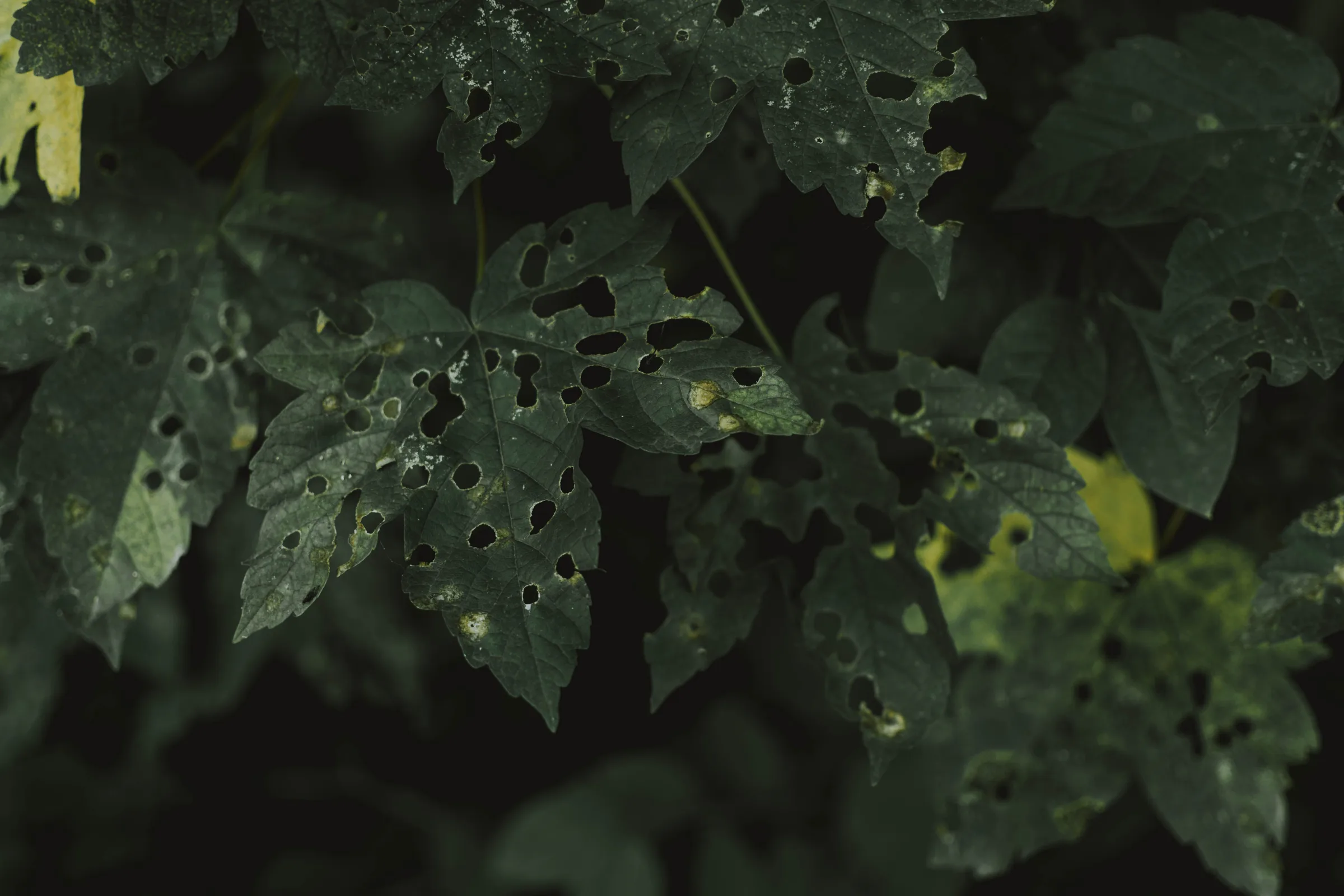
- Chewing insects (caterpillars, beetles): irregular holes, skeletonized leaves where only veins remain.
- Fungal diseases (powdery mildew, blights, leaf spots): powdery white coating, concentric ring spots, rapid spread in humid weather.
- Bacterial diseases: water-soaked lesions, ooze in humid conditions.
- Viral diseases: mottled or mosaic patterns of light and dark green, distorted leaves, often spread by an insect vector like aphids.
- Root and crown diseases: sudden collapse of seedlings, mushy dark roots, wilting that doesn’t recover after watering.
Where to Verify an Identification
Once you have a preliminary idea, cross-checking against an authoritative source prevents costly misdiagnosis: UC IPM (ipm.ucanr.edu) for research-based US identification guides, the RHS Pests & Diseases advice pages for UK horticultural authority, and CABI’s Plantwise Knowledge Bank for crop-specific diagnostic fact sheets used internationally. Checking a suspected identification against two of these sources is a reasonable way to catch a misdiagnosis before treating a plant based on a guess.
FAQ
Can a plant have a pest problem and a disease problem at the same time?
Yes — some insects act as vectors that transmit viral or bacterial pathogens while they feed, so an infestation can coexist with a virus the pests are spreading.
Do symptoms look the same on every plant species?
No. The same underlying pest or pathogen can produce different visible symptoms depending on the host plant, which is why host-specific identification guides are more reliable than generic symptom checklists.
Is it necessary to know the exact species before taking any action?
Not always. Narrowing a problem down to a category (sap-sucking insect versus fungal leaf spot) is often enough to choose a safe, low-risk first response.



